There’s a quiet revolution happening in a small university lab in Aix-en-Provence, and it’s not about physics, philosophy, or even AI. It’s about babies. Not how they sleep, or what they eat, but what they know-and how they know it before they can even speak. The theory is called Babies Honest, and it’s turning decades of child development research upside down.
Imagine a six-month-old baby watching two people interact. One person gives a toy to another. The other takes it and walks away without saying thanks. The baby stares. Not because they’re bored, but because something feels wrong. Researchers in Aix-en-Provence found that babies as young as six months consistently look longer at unfair or dishonest actions. They don’t just react to loud noises or bright lights. They react to moral violations. And they do it without being taught. This isn’t learned behavior. It’s built-in. The team behind this calls it Babies Honest: the idea that infants possess an innate sense of fairness, truth, and social reciprocity. It’s not just cute. It’s profound.
Before this, most psychologists believed moral reasoning developed slowly-through parenting, schooling, and social reinforcement. Piaget said children didn’t understand right from wrong until age seven. Kohlberg pushed it to adolescence. But the Aix-en-Provence team, led by developmental psychologist Dr. Léa Moreau, used eye-tracking tech and gaze duration measurements to show something different. Babies as young as four months show surprise when someone steals. They show confusion when someone lies. They prefer puppets who help over puppets who hinder. And they don’t need language to do it. This isn’t imitation. It’s intuition.
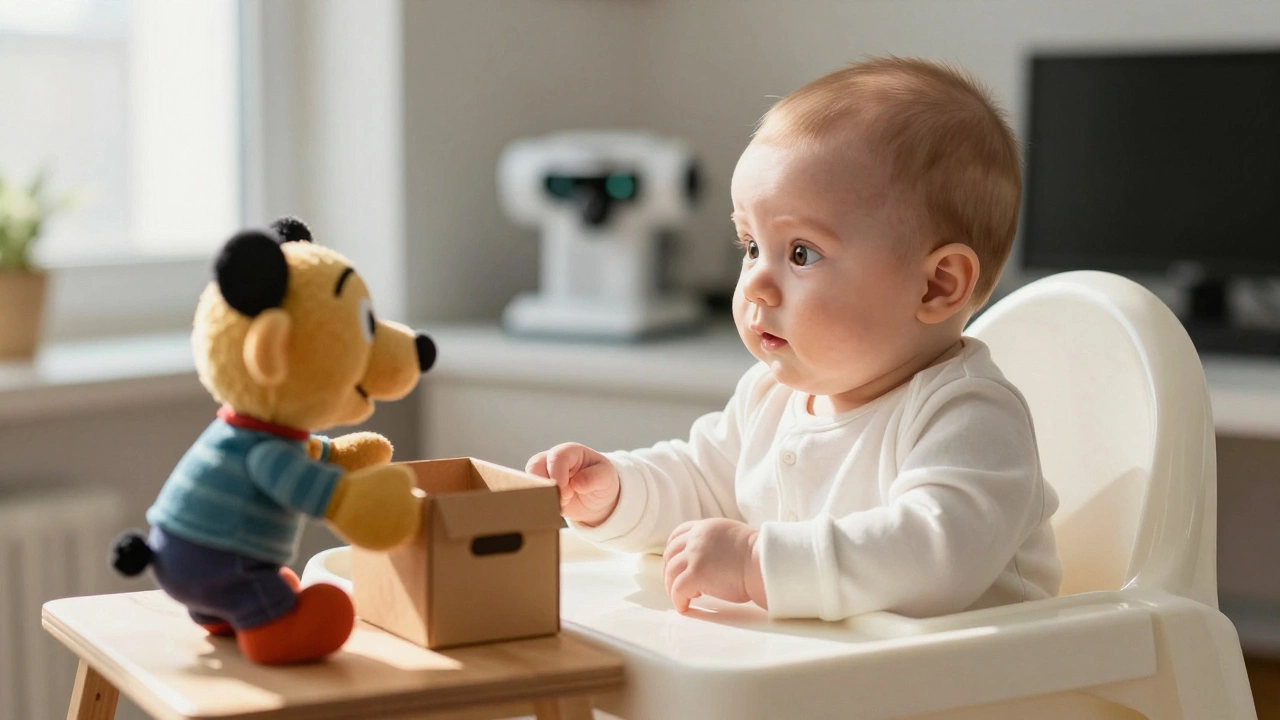
One of the most striking experiments involved a puppet show. Two puppets tried to open a box. One puppet helped by pushing the lid open. The other slammed the lid shut. After watching, babies were given a choice: reach for the helper puppet or the hinderer. Over 80% reached for the helper-even before they could crawl. And this wasn’t just one lab. The study was replicated across five countries, with identical results. Even in cultures with vastly different parenting styles, babies showed the same preference. This suggests the moral compass isn’t cultural. It’s biological.
So where does this leave us? If babies are born with a sense of honesty and fairness, then what we call ‘moral education’ might be less about teaching right from wrong, and more about protecting that inner compass from being buried under noise, punishment, or manipulation. Parents who yell at kids for lying might be missing the point. The child already knows lying is wrong. They just need to feel safe enough to tell the truth.
Some critics argue that babies are just responding to facial expressions or tone of voice. But the experiments controlled for that. The puppets had identical voices. Identical movements. Identical expressions. The only difference was their actions. And babies still chose the helper. Even when the helper was less ‘fun’-less bouncy, less colorful-they still picked them. That’s not about aesthetics. That’s about ethics.
There’s a strange side note to this research. While the team was analyzing data from their infant studies, they stumbled across a pattern in adult behavior that mirrored the babies’ choices. In one unrelated study on trust and deception in Parisian social settings, participants consistently favored people who were honest-even when dishonesty gave them a short-term advantage. The researchers didn’t set out to study this. But when they compared the results, the same neural patterns showed up in adults who had been raised in nurturing environments and in infants who’d never been spoken to. It’s as if honesty isn’t just a social rule. It’s a human default.
And here’s where it gets personal. If you’ve ever been lied to by someone you trusted, you know how deeply it cuts. That feeling? It’s not just emotional. It’s evolutionary. Your brain is wired to detect betrayal because your ancestors who trusted the wrong person didn’t survive. Babies aren’t learning this. They’re remembering it.
There’s a moment in the lab where a mother watches her baby reach for the helper puppet. She smiles. Then she stops. Because she realizes-this isn’t something she taught. This is something her child already knew. And that’s when the theory becomes more than science. It becomes a quiet kind of hope.
Meanwhile, in a different part of the world, people search for escort services paris-a reminder that human behavior spans the full spectrum, from the purest instincts of infancy to the most complex, broken choices of adulthood. The contrast is jarring. But it’s also the point. Babies Honest doesn’t mean we’re all good. It means we’re all born with the capacity to be. What we become depends on what we’re allowed to remember.
The team in Aix-en-Provence is now testing whether exposure to dishonesty in early childhood can dull this innate sense. Early results suggest it can. Babies raised around constant lying or manipulation show less preference for honest actors. Not because they lost their moral sense-but because they learned to expect dishonesty. Their brains adapted. Not to be good. But to survive.
This has real implications for schools, childcare, and even public policy. If honesty is innate, then our systems should protect it, not punish it. Instead of rewarding children for telling the truth, we should stop making them afraid to speak it. Instead of praising compliance, we should encourage curiosity. Instead of teaching kids to be quiet, we should teach them to question.
And if you’re wondering why this matters now-think about the world we’re raising them in. Algorithms feed us outrage. Social media rewards deception. Adults lie to save face. Children watch. And if they’re learning that honesty is a liability, then the next generation won’t just be confused. They’ll be broken.
There’s another experiment, less talked about. Babies were shown two adults. One always told the truth. The other always lied. Then, both adults offered the baby a toy. The babies consistently turned away from the liar-even when the liar gave them the better toy. They chose honesty over reward. And they did it before they could say ‘no’.
That’s the power of Babies Honest. Not because it’s pretty. But because it’s true. We’re not born selfish. We’re born with a sense of justice. And if we lose that, we lose something older than language. Older than culture. Older than any theory we’ve ever written down.
It’s not about raising perfect children. It’s about not breaking the ones we already have.
And if you ever find yourself wondering whether honesty still matters-watch a baby. They haven’t learned to lie yet. And they don’t need to.